

Italian design with a purpose in clinical spaces
Medical lighting is both working equipment and part of the clinical environment. Selection involves more than brightness: the proportions of the head and arms, how a team positions the light, and how it works alongside other equipment all matter. RIMSA offers Italian-designed surgical and examination lights with different optical and structural choices.
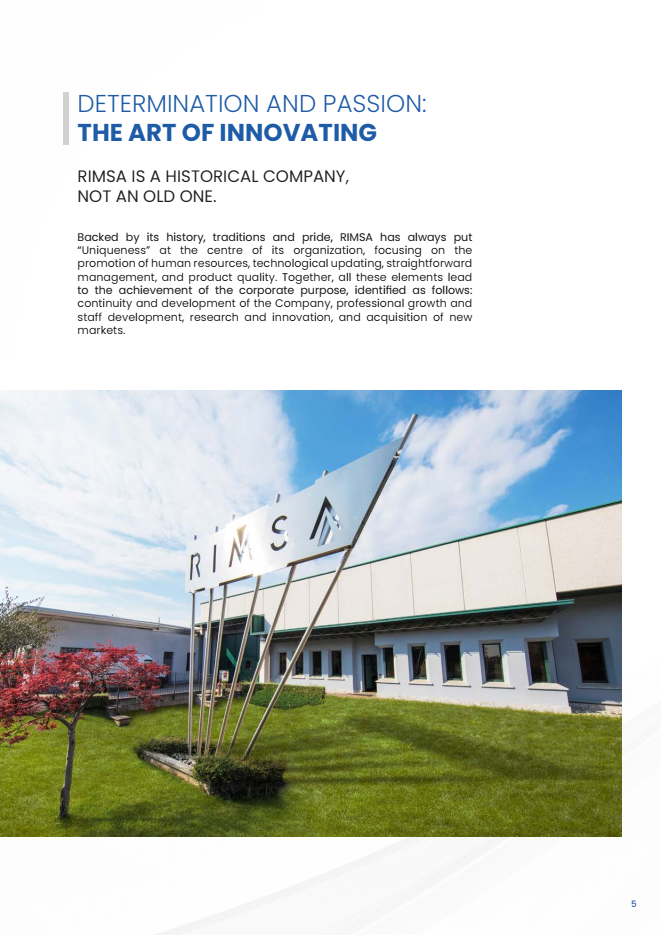
The value of Made in Italy should be tangible. RIMSA states that design and manufacturing are managed within its Italian facilities. Buyers can examine the model’s origin, construction, configuration and documentation rather than relying on provenance as a slogan alone.
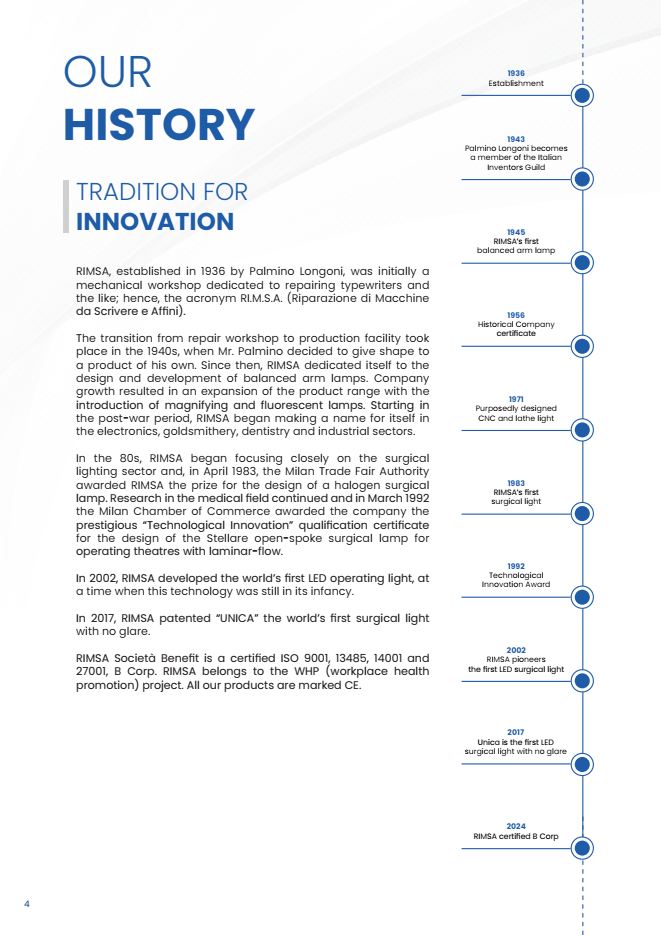
Since 1936: a history of continued development
Palmino Longoni established RIMSA in 1936. The company began with machinery repairs and progressed to balanced-arm lighting; its catalogue identifies a balanced-arm lamp milestone in 1945.
RIMSA developed its surgical-lighting activities during the 1980s. Manufacturer history describes LED operating-light development in 2002 and the introduction of UNICA with 2R Double Reflection in 2017. The relevant story is the progression from arm mechanics to optical design and control.
Beauty that can be evaluated in use
Flat heads, clean arm lines and different proportions allow appearance to be considered together with working clearance. UNICA 860 has an 860 mm head; UNICA 520 and U29 use 520 mm heads, while several PENTALED models use 400 mm heads.
Evaluate these dimensions alongside monitors, suspension arms and other overhead systems. A useful demonstration should cover grip, movement, stability after release, access to controls and cleaning according to manufacturer instructions. Design becomes more valuable when it works for the team’s daily routine.
2R Double Reflection: a defining UNICA feature
UNICA 860 and 520 use RIMSA’s double-reflection optical technology. The manufacturer describes its purpose as expanding the emitting surface and managing glare, alongside model-specific field and control features.
Both list 160,000 lux at 1 m and 3,800–5,400 K colour settings. Head size and field ranges differ, giving buyers room to consider the complete installation rather than output alone. 2R should be attributed to the listed UNICA models, not every RIMSA lamp.
Choices from examination rooms to operating theatres
- UNICA: evaluate 2R illumination together with controls, mounting and imaging requirements.
- U29: a compact 520 mm structure with indirect light and configuration-dependent ceiling or mobile options.
- PENTALED: different head sizes and field controls, including manual N-series adjustment, electronic 30E selection and the manufacturer-listed 12/28 applications.
- QUATTROLUCI LED / SATURNO LED: alternative structures and optical systems that require procedure-specific assessment.
- PRIMA / ALFA / L88 LED TW: examination models with jointed or flexible arms by model, and L88 optical magnification.
Assess value throughout the equipment lifecycle
Purchase price is one part of procurement. Compare installation, room compatibility, power requirements, maintenance, spare parts, documentation and the service terms actually offered. The catalogue’s LED-life figure above 60,000 hours is not the warranty period for the complete lamp and does not imply maintenance-free operation.
For future camera or integration plans, examine camera-ready provisions and supported equipment carefully. A prepared head does not mean the camera, cabling, monitor and all system components are already included. Clear requirements make quotations easier to compare.
Provenance and responsibility, supported by documents
RIMSA’s website lists ISO 9001, ISO 13485, ISO 14001 and ISO 27001 management systems and B Corp status. These address different aspects of the organization; they are not comparative lighting scores or a guarantee of clinical outcomes.
The catalogue also identifies EPD information for UNICA and U29. Where environmental criteria are relevant, request the current declaration applicable to the quoted model and verify its scope. Organization-level information should not substitute for product-specific documentation.
Bring Italian design into a configuration that fits your room
For teams considering Italian surgical lighting, RIMSA offers choices in form, optics and system accessories. The next step is a model and mounting configuration matched to the actual room, supported by specifications and a representative demonstration.
Explore RIMSA surgical lights, examination lamps, and the surgical-light buying guide, then request model advice and a quotation with your layout and workflow requirements.
Sources
Based on RIMSA Medical Catalogue Rev. January 2026, pp. 4–23, and the manufacturer’s surgical-light range. History, technology, manufacturing and corporate-status descriptions are attributed to the manufacturer. They do not guarantee treatment outcomes; confirm documentation and supply scope for the actual offered system.
คำถามที่พบบ่อย / FAQ
Where are RIMSA lights manufactured?
RIMSA states that design and manufacturing are managed in its Italian facilities. Check model and offered-product documentation.
When was RIMSA established?
Manufacturer history states that Palmino Longoni established RIMSA in 1936.
How should the value of Italian lighting be assessed?
Evaluate design details, positioning, model-specific optics, documentation, installation and the actual offered service terms.
Is an LED life above 60,000 hours the warranty?
No. It is a manufacturer LED-life specification. Product warranty and service conditions are defined in the actual offer and warranty documents.
Find out more
Products in this article

RIMSA Italian Surgical Lights: UNICA, U29 & PENTALED
Italian-designed and manufactured RIMSA LED surgical lights. Compare 11 models, 2R and indirect-light technologies, specifications at 1 m, ceiling/wall/mobile o…
View product
RIMSA Italian Examination Lamps: PRIMA, ALFA & L88 LED
Explore Italian RIMSA examination lights: PRIMA FIX/FLEX, ALFA FIX/FLEX and L88 LED TW, with model images, illumination data, arm choices, magnification and mou…
View product