

Choose surgical lighting for the team’s workflow, beyond a single lux figure
The right surgical light should fit the working area, allow practical positioning and provide a field suited to the procedure. Compare illuminance together with measurement distance, field size, shadow management, glare, colour temperature, controls and installation. A high output figure alone does not describe the complete lighting experience.
RIMSA designs and manufactures medical lights in Italy. Its range includes different optical systems and head structures, making model-by-model comparison more useful than treating every lamp as the same technology.
1. Begin with the procedure and working distance
An operating room, minor-procedure room, emergency area and examination room have different requirements. Provide the intended specialty, patient position, ceiling height and overhead equipment before specifying the light.
RIMSA’s surgical tables list illuminance at 1 m, while PRIMA and ALFA examination models are measured at 0.5 m. PRIMA’s 115,000 lux therefore cannot be directly compared with PENTALED 12’s 100,000 lux without considering the different reference distances.
2. Understand the light-emitting surface
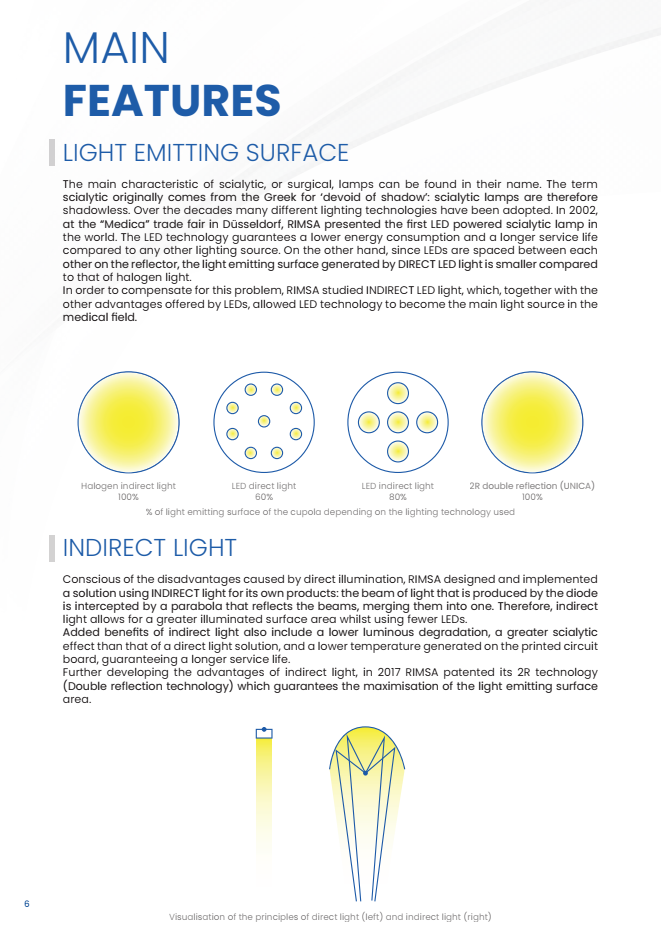
RIMSA distinguishes the area occupied by individual LEDs from the effective emitting surface. Counting visible LEDs does not describe the whole optical performance. Reflective systems are used to expand the emitting area and shape the delivered light.
During a demonstration, evaluate the field with team members around the table and hands or instruments entering the beam. Reposition the head and observe the field under the conditions in which it will actually be used.
3. Direct light, indirect light and 2R
Direct-light designs deliver illumination through their LED and lens system. Indirect-light designs first direct the beam onto a reflective surface. RIMSA describes the latter approach as a way to increase the emitting area and manage glare.
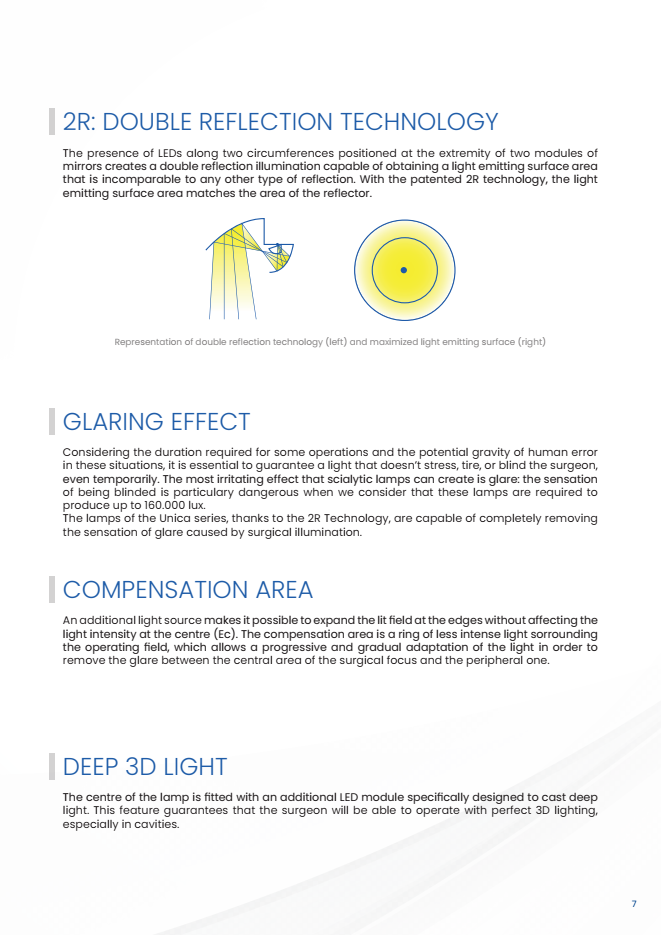
UNICA 860 and UNICA 520 use RIMSA’s 2R Double Reflection technology. U29 and selected PENTALED models use indirect light, while QUATTROLUCI LED, PENTALED 28 and SATURNO LED use direct light. 2R should not be presented as a universal feature across the range.
The manufacturer’s “zero glare” wording describes its design claim. Evaluate visual comfort during a representative demonstration; it is not a guarantee that every user will experience no fatigue or that clinical outcomes will improve.
4. Compensation Area and the transition around the field
RIMSA describes a lower-intensity illuminated area surrounding the central working field, intended to create a more gradual brightness transition. Evaluate the centre, edge and surrounding area while varying field diameter and output.
Confirm the feature on the quoted model. It is listed on UNICA, U29 and selected PENTALED models, rather than being an automatic inclusion on every series.
5. Deep 3D Light and focus adjustment
Deep 3D Light is the manufacturer’s description of illumination directed into the depth of the working area. Assess the field and focusing method for the intended workflow, rather than relying only on illumination displayed on a flat surface.
PENTALED N models use manual field adjustment at the central handle. PENTALED 30E selects two field sizes at the keypad. Models listing Always on Focus have the manufacturer’s corresponding focusing design. Confirm the exact feature set for each model.
6. A practical starting point across the RIMSA range
- UNICA 860 / 520: consider these for 2R Double Reflection, 3,800–5,400 K colour selection and adjustable fields. Both list 160,000 lux at 1 m; head diameters are 860 and 520 mm respectively.
- U29: a 520 mm head with indirect light, 4,500–5,000 K colour settings and a 140–230 mm field, with configuration-dependent imaging and mounting options.
- PENTALED 63N / 30N / 30E: compare head dimensions and the manual or electronic field-adjustment method.
- PENTALED 30E LIGHT / QUATTROLUCI LED: compare their different structures and optical systems against ceiling-space requirements and other overhead equipment.
- PENTALED 12 / 28 / SATURNO LED: starting points for manufacturer-listed minor-procedure settings, subject to the actual field and installation requirements.
- PRIMA / ALFA / L88 LED TW: a separate examination range. PRIMA adds ambient lighting, ALFA a compact head and L88 optical magnification.
7. Italian design should contribute to daily use
Clean lines and considered proportions matter, but assess grip, movement, stability after release, clearance around the patient, access to controls and manufacturer cleaning instructions as well. Appearance and practical use should be assessed together.
RIMSA states that its design and manufacturing processes are managed in its Italian facilities. Model documentation, construction details and a demonstration make that provenance more tangible than a country-of-origin label alone.
8. Camera-ready does not mean camera-included
The January 2026 catalogue lists UNICA and U29 heads as camera-ready. Full HD/4K cameras, wired or wireless links, monitors, support arms and integration require compatibility and quotation checks.
The same applies to mobile bases, batteries, wall panels and IR remotes. A listed LED life above 60,000 hours is a manufacturer specification, not the product warranty period.
Seven details for a useful quotation and demonstration
- Procedure types and specialty.
- Room dimensions, ceiling height and overhead plan.
- Number of heads and preferred mounting.
- Ceiling equipment and monitors that must work alongside the lights.
- Camera, recording and integration requirements.
- Electrical, battery and engineering requirements.
- Preferred models, procurement timing and demonstration needs.
Compare all 11 RIMSA surgical models, explore RIMSA examination lamps, then request a configuration and quotation.
Sources and scope
Based on RIMSA Medical Catalogue Rev. January 2026, pp. 6–23, and the manufacturer’s surgical-light range with the model pages linked from our products. Technology descriptions and specifications are manufacturer information, not independent comparative testing. Confirm current models and options in the final offer.
คำถามที่พบบ่อย / FAQ
What matters when choosing a surgical light?
Assess workflow, measurement distance, field size, shadow management, glare, colour, controls and installation together, rather than lux alone.
Which RIMSA models use 2R?
UNICA 860 and UNICA 520 list 2R Double Reflection. Other models use their specified optical systems.
Can an examination lamp replace a surgical light?
Do not decide on output alone. Verify manufacturer intended use, performance at the working distance and procedure requirements.
Does camera-ready include a camera?
No. Confirm camera, cabling, monitor and integration in the actual supply scope.
What is needed for a surgical-light quotation?
Provide specialty, room layout, ceiling height, number of heads, mounting, electrical requirements and camera or demonstration needs.
Find out more
Products in this article
RIMSA Italian Surgical Lights: UNICA, U29 & PENTALED
Italian-designed and manufactured RIMSA LED surgical lights. Compare 11 models, 2R and indirect-light technologies, specifications at 1 m, ceiling/wall/mobile o…
View product
RIMSA Italian Examination Lamps: PRIMA, ALFA & L88 LED
Explore Italian RIMSA examination lights: PRIMA FIX/FLEX, ALFA FIX/FLEX and L88 LED TW, with model images, illumination data, arm choices, magnification and mou…
View product