
How to choose a medical suction unit
Begin with the clinically assessed task, setting, frequency, expected secretion volume, handling and available power. Then compare adjustable vacuum, airflow, collection, liquid protection and after-sales support. Maximum vacuum alone does not determine suitability.
1. Distinguish oral, airway and procedural suction
Suction covers different tasks: oral secretion removal, artificial-airway suction and procedural liquid collection require different accessories and techniques. Home care needs individual assessment and carer training, rather than selection based only on a diagnosis or review.
2. Vacuum and airflow describe different properties
Vacuum in kPa describes negative pressure; L/min describes airflow under the stated test conditions. TAF-W’s −90 kPa and KS-710’s −75 kPa are maximum equipment values, not prescribed patient settings. Pump-only airflow is not the volume of sputum or liquid aspirated per minute.
3. Match collection capacity to the workflow
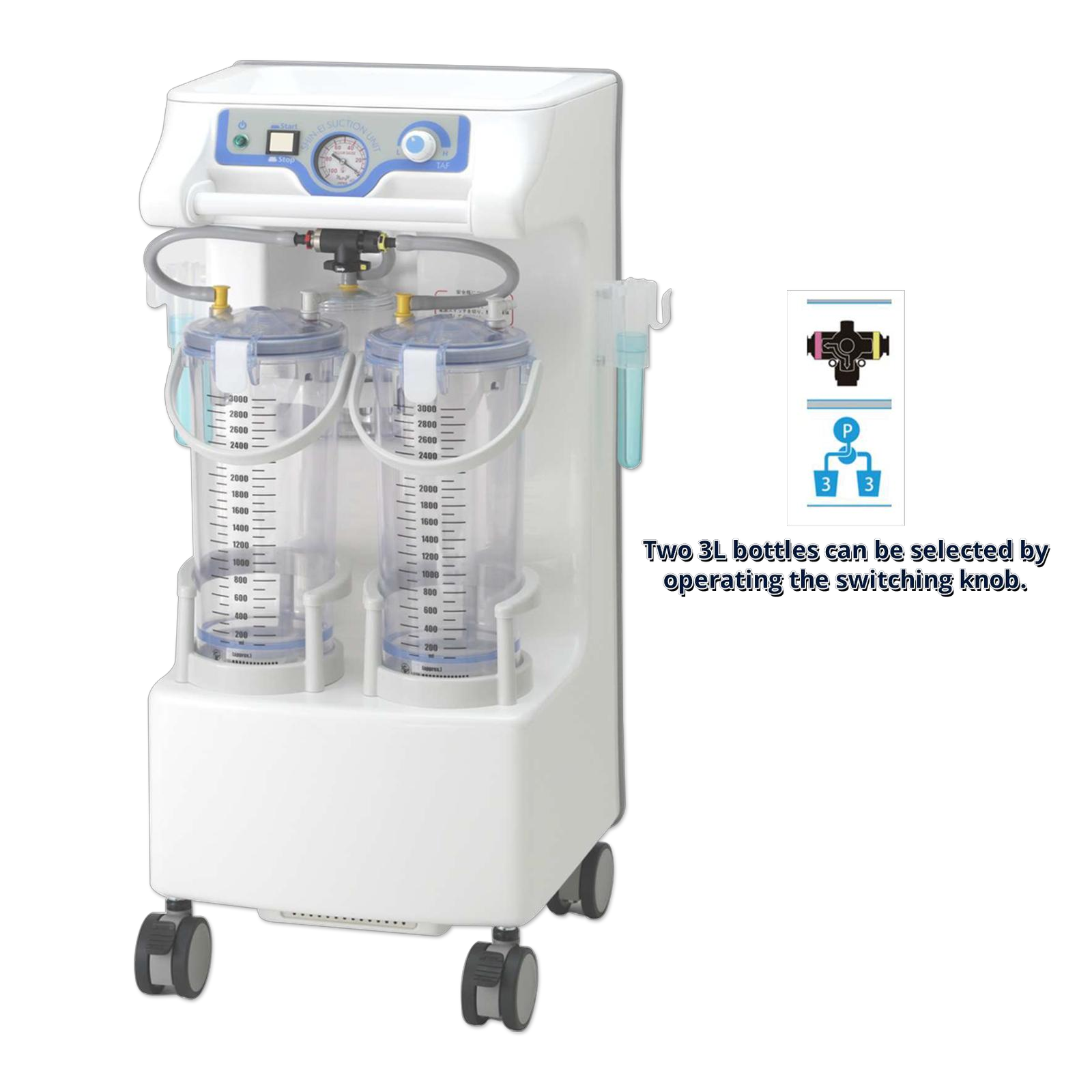
A smaller bottle supports compact equipment but needs an appropriate level-checking and emptying plan. Larger collection capacity must fit the department’s fluid volume and available space. TAF-W has two selectable 3 L bottles, not simultaneous channels; KS-710 has a 700 mL ±50 mL bottle. Do not wait for overfilling.
4. Read mains, battery and duty ratings separately
The supplied TAF-W manual specifies AC 220 V, 50–60 Hz. KS-710 uses an AC 100–240 V adapter, with a dedicated battery/charger or 12 V car cord available as separate options. Its 30-minute continuous-operation rating is neither a patient suction duration nor a battery-runtime guarantee. The car cord does not charge the battery.
5. TAF-W versus POWER SMILE S KS-710
TAF-W: trolley unit, approx. 21 kg main-unit weight, two selectable 3,000 mL bottles, maximum vacuum −90 kPa ±10%, and pump-only airflow of 78 L/min ±20% at 50 Hz or 92 L/min ±20% at 60 Hz. Assess where greater collection capacity, mains power and floor space are available.
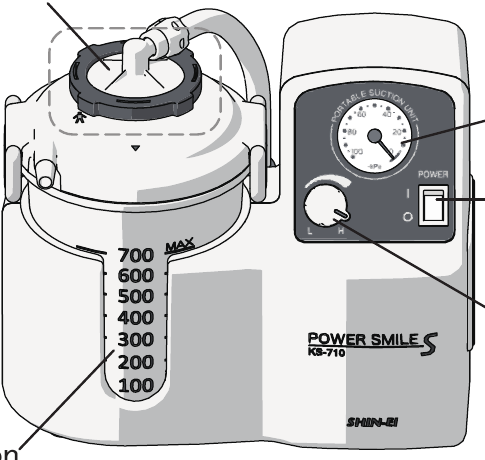
POWER SMILE S KS-710: portable unit, approx. 1.5 kg main-unit weight, 700 mL ±50 mL bottle, maximum vacuum −75 kPa ±10%, and pump-only airflow of 17 L/min ±20%. Consider where compact handling matters, subject to professional assessment of performance and accessories.
6. Liquid protection requires inspection
Identify the safety bottle, float, sensor or filter supplied with the quoted model and learn correct assembly. Protective components do not replace liquid-level monitoring. Wet or blocked filters and leaking tubes can affect suction. Follow each model’s cleaning and disinfection instructions; components may require different treatment.
7. For home care, arrange a demonstration
Ask the carer to practise assembly, gauge reading and pre-use checks and review the care team’s plan. CUH NHS oral-suction information emphasises professional demonstration. AARC’s 2022 guideline addresses artificial-airway suction, a different task from oral suction; generic settings or techniques should not be applied to every patient.
8. Consider consumables and service costs
Request prices for compatible filters, bottles, lids, seals, floats, tubing and batteries, together with training, inspection, warranty and servicing. A stated service life is not a warranty period. Discuss backup equipment or power where interruption would affect the care plan.
Seven details for an accurate quotation
- Oral, airway or procedural task.
- Hospital, clinic or home setting.
- Frequency and approximate liquid volume.
- Carrying or wheeled movement.
- Mains availability or required battery option.
- Clinician-specified patient accessories and consumables.
- Demonstration, training, maintenance and backup needs.
Patient names, medical records and personal health information are not needed to begin a product enquiry.
Explore the models and request a configuration
Explore TAF-W trolley suction, POWER SMILE S KS-710 portable suction, or all medical suction units, then request a configuration and quotation for your workflow.
Sources and scope
Specifications are from the supplied USER MANUAL TAF-W, Maintenance manual TAF-W and Power Smile S_English version. This is equipment-selection information, not a patient-specific suction plan. Selection and training context draws on MHRA: Devices in practice, CUH NHS: Oral suction at home and AARC 2022: Artificial Airway Suctioning, checked 20 October 2026. These references do not constitute endorsement of either product.
คำถามที่พบบ่อย / FAQ
Is higher maximum vacuum always better?
No. Consider the assessed task, adjustability, airflow, collection and workflow. Maximum equipment vacuum is not a patient setting.
Should I choose TAF-W or KS-710?
TAF-W is a trolley with two selectable 3 L bottles; KS-710 is portable with a 700 mL bottle. Decide by workload, handling, power and professional assessment.
Do home carers need suction training?
Yes. Arrange professional assessment and demonstration of pre-use checks, the prescribed technique, cleaning and a backup plan.
Does every portable unit include a battery?
No. The supplied KS-710 manual lists an AC adapter as standard and a dedicated battery/charger as optional.
Find out more
Products in this article
TAF-W Medical Suction Unit with Two 3 L Bottles
Japanese TAF-W trolley medical suction unit with two selectable 3 L bottles. Explore vacuum, pump airflow, liquid protection and quotation options.
View productPOWER SMILE S KS-710 Portable Suction Unit
Japanese POWER SMILE S KS-710 portable suction unit, approx. 1.5 kg with a 700 mL bottle. AC adapter included; dedicated battery and car cord are optional.
View product