
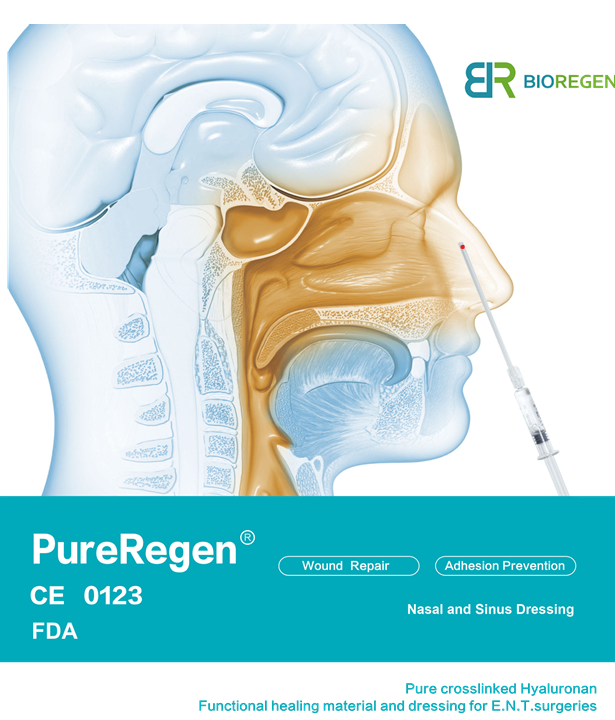
PureRegen® Gel Sinus is a self-cross-linked hyaluronic acid hydrogel used as a dressing in the nasal and sinus cavities after surgery. Some studies support benefits for mucosal recovery and adhesion reduction. Outcomes depend on the comparator, surgical site and accompanying postoperative care. [1–4]
Why does the choice of dressing after sinus surgery matter?
After endoscopic sinus surgery (ESS), wound healing and tissue adhesions are important follow-up considerations. Dressings differ in their properties, including bleeding control, separation of tissue surfaces and support of nasal structures. Selection should reflect the intended purpose and the patient's circumstances. [1,3]
PureRegen Gel Sinus is one HA gel option studied directly after ESS. Assessment should consider both clinical findings and suitability for each surgical site. [1,2]
How does PureRegen Gel Sinus differ from nasal packing?
Nasal packing is a broad term covering materials such as sponges, foams and gels. PureRegen Gel Sinus is a resorbable HA gel. Comparisons should therefore identify the specific material and product rather than suggesting that one type is superior to every alternative in every respect. [1,3]
Choosing a material for the wound surface may involve different considerations from choosing support for the middle turbinate. The comparison with Posisep illustrates this distinction. [3]
What do clinical studies report?
1. Comparison with CMC foam after ethmoidectomy
Matheny and colleagues published a study in the American Journal of Rhinology & Allergy in 2014 involving 30 patients undergoing bilateral ethmoidectomy. One side received PureRegen and the other carboxymethylcellulose (CMC) foam, Stammberger Sinu-Foam, under randomized allocation. Twenty-nine patients completed follow-up. [1]
The PureRegen-treated side had significantly lower synechiae and overall endoscopic wound grades at 6 and 12 weeks. Edema, crusting and mucopurulent drainage at 1–2 weeks were not significantly different. Remucosalization showed a favorable trend that did not reach statistical significance. [1]
2. Mucosal recovery after ESS
Shi and colleagues studied 55 patients undergoing bilateral ESS in 2013; 54 completed follow-up. One side received additional HA gel and the other did not, alongside the study's postoperative care. [2]
Re-epithelialization was significantly improved at weeks 2, 4 and 8. Overall analyses across follow-up supported reductions in adhesions, edema and crusting. Overall findings should not be interpreted as a significant difference in every measure at every visit. [2]
3. Comparison with Posisep: consider middle turbinate support
Chen and colleagues, published in The Laryngoscope in 2023, compared Posisep and PureRegen after ESS. Posisep was associated with less middle turbinate lateralization and fewer adhesions, but dissolved more slowly and caused more mucosal edema. [3]
The need for middle turbinate support is therefore one consideration in selecting a dressing. Findings against CMC should not be generalized into a claim that PureRegen reduces adhesions better than all other materials. [1,3]
4. Comparison with Chitogel plus triamcinolone
Cavada and colleagues studied 40 patients in 2025, comparing Chitogel with triamcinolone in one side of the sinuses and PureRegen in the other. No statistically significant differences were found in the wound-healing outcomes assessed. [4]
However, failure to find a statistically significant difference does not establish equivalence. These findings should not be used to conclude that PureRegen replaces steroid treatment.
Considerations before choosing a sinus dressing
- The primary goal: wound-surface care, tissue separation, bleeding control or structural support.
- The location and extent of surgery, including middle turbinate stability.
- Follow-up, irrigation and accompanying treatment prescribed by the clinician.
- Indications, contraindications and instructions for the specific product actually used.
Most studies discussed followed patients for approximately 12 weeks. They should not support guarantees of preventing all adhesions, reducing long-term revision surgery or suitability for every patient. The 2013 and 2014 studies received manufacturer support, which should be considered when interpreting their findings. [1,2]
Request PureRegen Gel Sinus information for your organization
Clinicians, operating-room staff and procurement teams seeking specifications, product instructions or supporting studies can view PureRegen Gel Sinus product information or contact Tawanmcweis.
This article is provided by the distributor as product information and a summary of research evidence. It does not replace patient assessment or medical advice.
References
- Matheny KE, et al. Self-cross-linked hyaluronic acid hydrogel in ethmoidectomy: A randomized, controlled trial. Am J Rhinol Allergy. 2014;28:508–513. DOI: 10.2500/ajra.2014.28.4106.
- Shi R, et al. The clinical outcomes of new hyaluronan nasal dressing: A prospective, randomized, controlled study. Am J Rhinol Allergy. 2013;27:71–76. DOI: 10.2500/ajra.2013.27.3833.
- Chen I, et al. Posisep Versus PureRegen Gel for Post ESS Nasal Packing – A Randomized Blinded Prospective Study. Laryngoscope. 2023;133:1834–1838. DOI: 10.1002/lary.30468.
- Cavada MN, et al. Double-Blinded Randomised Controlled Trial Evaluating the Efficacy of Chitogel Versus PureRegen Gel on Postoperative Outcomes from Endoscopic Sinus Surgery. Am J Rhinol Allergy. 2025;39:211–219. DOI: 10.1177/19458924251321142.
คำถามที่พบบ่อย / FAQ
Can PureRegen be used after sinus surgery?
Studies have directly assessed PureRegen Gel Sinus after ESS and ethmoidectomy. Actual use must follow the product's indications and clinical judgment. [1,2]
Does PureRegen reduce adhesions after sinus surgery?
The 2014 study supported reduced synechiae compared with CMC foam. This does not mean that all adhesions are prevented or that the product is superior to every other material. [1,3]
Can PureRegen replace materials used to support the middle turbinate in every case?
That conclusion is not supported. The Posisep comparison found differences in middle turbinate support. Wound-surface care and structural support should be considered as separate goals. [3]
Is PureRegen the worldwide standard for dressing after sinus surgery?
Research publications or availability in several countries do not establish a national or worldwide standard. Based on the evidence cited here, it is more appropriate to describe it as a sinus dressing option supported by clinical studies.
What postoperative care is needed when PureRegen is used?
Follow the treating clinician's care and follow-up plan. Gel use is not a reason to stop wound follow-up or adjust treatment independently. Studies included accompanying postoperative care, so a single trial's protocol should not automatically be applied to every patient. [1,2]
Find out more
Products in this article
PureRegen
PureRegen® Gel SINUS คือ เจลแต่งแผลในโพรงจมูกและไซนัสชนิดสลายตัวได้เอง (Self-crosslinked Hyaluronic Acid Gel Dressing) ผลิตจากสารไฮยาลูโรนิกแอซิดที่ผ่านกระบวนกา…
View product